
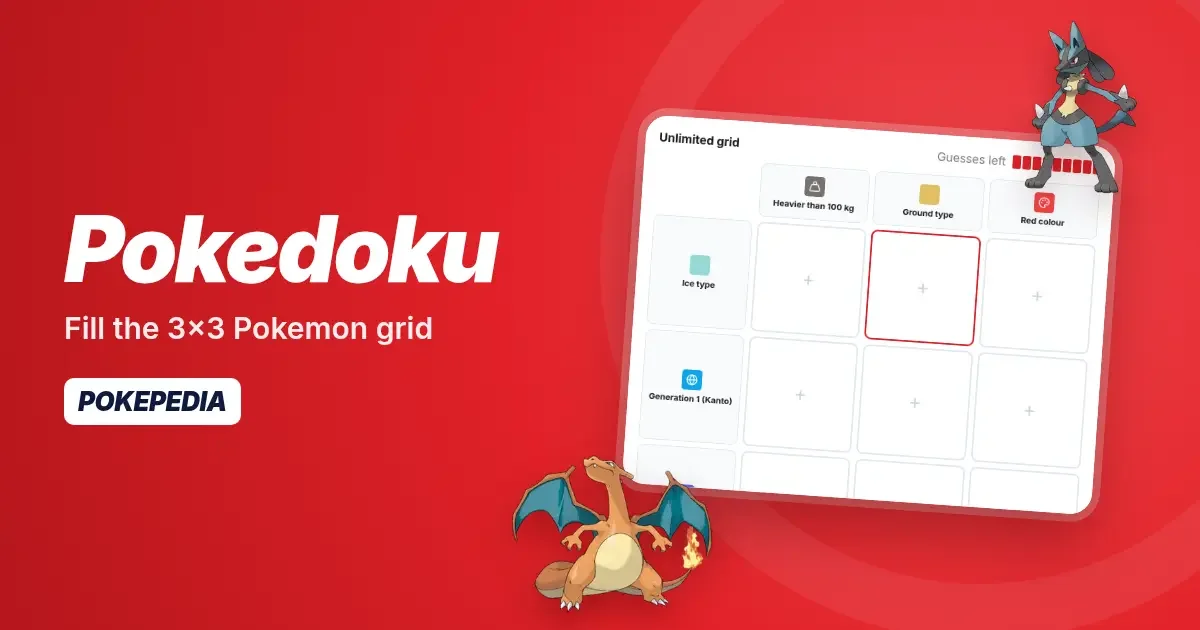
What is Pokedoku?
Pokedoku is a Pokemon trivia game on a 3x3 grid. Three categories run across the top as columns and three run down the side as rows, such as Fire type or Generation 1. Each box needs a Pokemon that fits its row and column. You have nine guesses to fill the 9 boxes, and each Pokemon can be used once per grid. Many boxes have multiple correct answers, so the player decides which Pokemon goes where.
This page has a new daily puzzle every day and an unlimited mode with difficulty settings. It is a fun test of what a fan knows about the Pokemon theme. Pokepedia is an independent fan site. It is not affiliated with pokedoku.com. It has no link to Nintendo or The Pokemon Company.
How to play Pokedoku
- Read the 3 column categories above the grid and the 3 row categories beside it. These are the row and column rules for the puzzle.
- Tap a square. A search box opens under the grid.
- Type a Pokemon name into the input and pick it from the list. Choose the correct Pokemon for that square.
- A match fills the square with that Pokemon's sprite. A miss shows a short reason and uses one guess.
- Keep going until the grid is full or the 9 guesses are gone.
The correct answer fills the square, and a wrong one does not. Both use a guess. A grid can end with fewer than 9 squares filled. Picking the same wrong Pokemon for the same square again costs nothing. The Give up button ends the grid early and shows the answers.
When the grid ends, each square lists how many Pokemon fit it. Open View answers to see them all with their sprites, each linked to its page in the Pokedex.
Pokedoku categories explained
Categories are worked out from Pokemon data and always match the Pokedex on this site.
| Category | What counts | Example |
|---|---|---|
| Type (all 18) | The type is one of the Pokemon's types | Gengar counts for Ghost and for Poison |
| Generation 1 to 9 | The generation the Pokemon first appeared in, shown with its region | Generation 1 is Kanto |
| Legendary | Marked as a Legendary Pokemon in the data | Mewtwo |
| Mythical | Marked Mythical in the data | Mew |
| One type only, Two types | Counts the types the Pokemon has | Charizard has two |
| Basic stage that evolves | Starts an evolution line and has an evolution | Pichu |
| Fully evolved | Evolved from another Pokemon and has no further evolution | Snorlax |
| Does not evolve | No evolution and not an evolution | Ditto |
| Colour | The Pokedex colour listed in the data | Red |
| Body shape | The listed body shape. Only shapes with enough Pokemon are used | Quadruped |
| Taller than 2 m | Height over 2 metres | Snorlax is 2.1 m |
| Heavier than 100 kg | Weight over 100 kilograms | Snorlax is 460 kg |
| Base stat total 600+ | The six base stats add up to 600 or more | Garchomp |
Colour and body shape use the labels in the data, which can differ from how a Pokemon looks in a picture. If a square is unclear, hover over its category for a short definition.
How Pokedoku scoring and rarity work
Your main score is the number of squares filled out of 9. A second number, the rarity score, rewards narrow squares. A filled square scores 100 divided by the number of Pokemon that fit it. A square with 2 possible answers gives 50 points, a square with 20 gives 5.
The rarity score is worked out from the Pokemon data on this site. It does not use what other players picked. Two grids with the same number of squares can have very different rarity, because one may be full of crowded squares and the other full of tight ones.
Pokedoku tips
- Start with the tightest square, usually where two narrow categories cross, such as Mythical and a type. Few Pokemon fit, and you do not want to spend one on a different square first.
- Hold back Pokemon that fit many squares. A Pokemon used early is gone for the rest of the grid.
- Think in evolution lines. A Fully evolved square with a generation usually takes the last form of a line from that generation.
- Check type counts. Mono-type and Dual-type squares rule out half the Pokedex at once.
- Read the miss message. It names the category your pick failed, which tells you what to change.
- Learn the big and heavy Pokemon. Squares for height over 2 m or weight over 100 kg are mostly large final forms.
The Pokemon type chart and the Pokedex help with type and generation squares. Use them between grids to learn which Pokemon fit which categories.
Pokedoku for beginners
Start on Easy in unlimited mode. Easy grids use broad categories, so most squares have plenty of answers. Once you finish a few grids with 9 squares, move up to Normal, which is also the level of the daily grid.
Type and generation squares are the quickest to learn. Most players know a handful of Pokemon for each type, and the generation label names a region, which helps you recall the games where a Pokemon first showed up. Evolution squares take longer, because you need to know whether a Pokemon is the first, middle or last form of its line.
Measurement squares reward a different kind of knowledge. A Pokemon that looks huge in the games may sit just under 2 metres, and a small one can be heavy. When a Taller than 2 m or Heavier than 100 kg square comes up, open the Pokedex page of a guess to check its height and weight before you commit.
Why some Pokedoku squares have so few answers
A square only has as many answers as there are Pokemon in both categories. Legendary and Mythical are small groups, and crossing either with a colour or a body shape leaves very few Pokemon. Base stat total 600+ is also small, and it overlaps heavily with Legendary and with fully evolved Pokemon.
Wide categories give wide squares. A type crossed with a generation often has a dozen or more answers. After a grid ends, the possible answers list shows the exact count for each square, so you can see which squares were tight and which were open.
Making Pokedoku harder
Hard mode in unlimited play picks grids where squares have as few as 1 to 6 answers. Narrowing the grid to one generation also makes it harder, since the categories and answers both shrink. A single generation on Hard is a good test for anyone who knows the Pokedex well.
Play Pokedoku unlimited
The daily grid is the same for everyone in the same time zone. It is built from the puzzle number and stays the same after a reload. Your progress is saved in your browser, and a reload brings back the grid as you left it. Only the daily grid counts toward your stats and streak.
Unlimited mode builds a fresh grid on demand. Easy gives each square 15 or more answers. Normal gives each square at least 3. Hard allows squares with as few as 1 to 6 answers. You can also limit the grid to chosen generations, which restricts both the categories and the answers. The difficulty and generation settings are remembered on your device.
Grids are checked before they reach you. No category repeats, no square is empty, and the squares can all be filled with different Pokemon.
Share result copies a 3x3 grid of green checks and red crosses with your score and the puzzle number. It shows which squares you filled and never names a Pokemon.
Pokedoku archive
The daily tab has a Practice row with the last 7 daily grids. Pick one to play that day as it was. Practice grids are never counted in your stats. Try a different approach on them freely. The row appears once there are past grids to show.
The Pokemon data behind the grids
The game draws on 1,025 Pokemon from all nine generations and encompasses different regions from Kanto onward, base forms only. Types, generations and evolution stages come from the same data as the Pokedex. Size, colour, shape and base stats do too. Regional forms and Mega Evolutions are not separate entries.
Browse the pages for Ditto or Garchomp to see the values the categories use. The random Pokemon generator is another way to meet Pokemon you do not know yet.
More Pokemon grid and trivia games
If you like a Pokemon grid puzzle, the Pokemon games page lists all the games on Pokepedia, from daily guessing games to quizzes.