
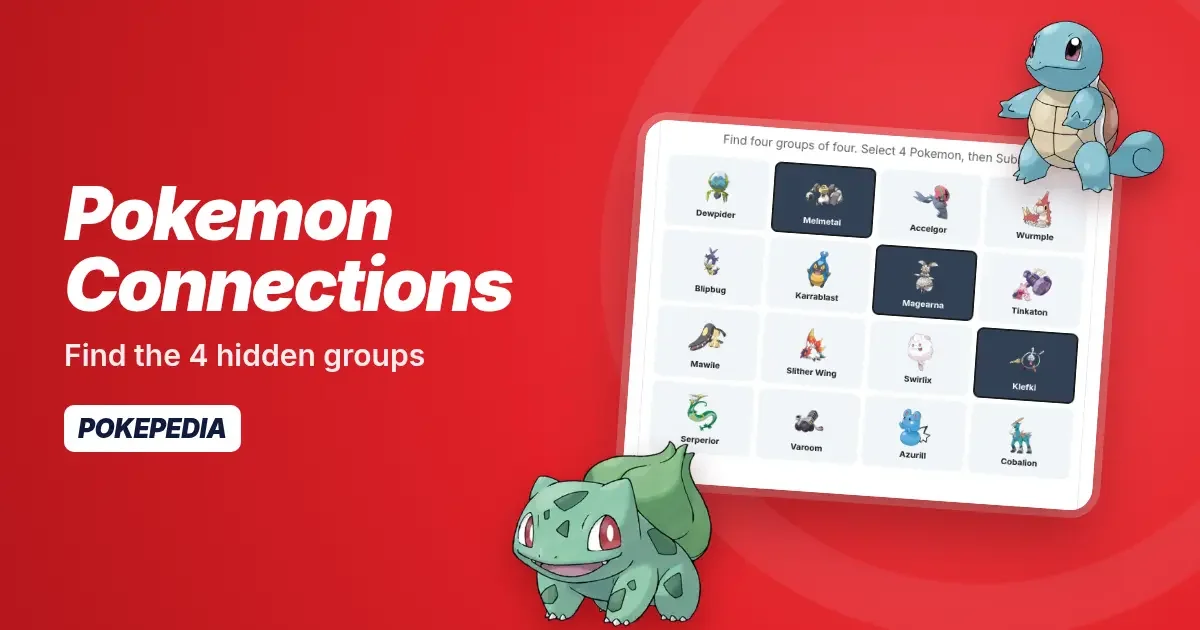
What is Pokemon Connections?
Pokemon Connections is a free daily puzzle game. A board shows 16 Pokemon with their sprites. They split into four hidden groups of four, and each group shares one trait such as a type, a generation or a first letter. Select four Pokemon and press Submit. Four wrong guesses end the game.
Every group comes straight from the Pokepedia Pokedex data. The game picks a category, finds Pokemon that fit it, and checks the finished board so that each category matches exactly four tiles. If a group is Pure Water-type, no fifth Pure Water-type is hiding on the board. A puzzle never has two valid answers.
How to play
- Read all 16 names and sprites on the board.
- Tap four Pokemon that you think share a trait. Tap a selected tile again to remove it.
- Press Submit. A correct group collapses into a coloured bar with its category name.
- A wrong group costs one of your 4 mistakes. If three of the four were right, the game says One away.
- Use Shuffle to reorder the remaining tiles and Deselect all to clear your selection.
- Solve all four groups to win. Press Share result to copy a grid of coloured squares.
The game works with a mouse, a keyboard or a touch screen, and the board fits a 360 pixel wide phone.
What the four colours mean
The colour of a bar tells you how hard the group was meant to be.
| Colour | Difficulty | Typical categories |
|---|---|---|
| Yellow | Easiest | A single type, a generation, Legendary or Mythical Pokemon |
| Green | Medium | A Pokedex colour, a body shape, a dual-type pair such as Bug/Flying |
| Blue | Hard | The same first letter, height over 2 metres, weight under 1 kilogram, base stat total of 600 or more |
| Purple | Hardest | Names that share their first or last three letters, or a pure type that usually comes paired |
A bar keeps its colour whatever order you solve the groups in, and the share grid uses the same four colours.
Categories that can appear
Type groups
A pure type group lists Pokemon with only one type, such as Pure Ice-type. A dual-type group asks for a pair, such as Dark/Grass. Check the type chart if you want to refresh which types exist.
Generation and status groups
A generation group uses the region where a Pokemon first appeared, from Kanto in generation 1 to Paldea in generation 9. Status groups use the Legendary and Mythical labels. Browse the legendary Pokemon page for the full list.
Colour and shape groups
The Pokedex gives every Pokemon a colour and a body shape. A group of white Pokemon can include very different species. The colour comes from the Pokedex entry on each Pokedex entry.
Number and name groups
These groups use height, weight, base stat total, the first letter of the name, or letters inside the name. Gastly, at 0.1 kilograms, and Onix, at 8.8 metres, show how far the size groups can stretch.
Strategy tips
- Start with the most specific trait. If four tiles are Legendary Pokemon, that group is probably yellow.
- Look for a trait that matches five or more tiles. One of those tiles belongs to another group, and finding which one is the puzzle.
- Watch for red herrings. A board often has a few Water-types in different groups, and only the group named Pure Water-type needs four with Water alone.
- Say each name out loud. Name groups, such as the same ending, are easier to hear than to see.
- Leave the purple group for last. Once three groups are solved, the final four tiles are the answer.
- Use Shuffle when you are stuck. A new order often shows a pattern you missed.
When a guess comes back as One away, keep the three tiles you trust and change the fourth. Try a different replacement each time, and write down the ones that failed.
Ideas for solving faster
Boards mix groups from different clue families on purpose, so a type group, a name group and a number group often share one board. Sort the tiles by what you can check from memory first. Types and generations are quick to recall for most players. Heights and weights are harder, so keep them for the end.
Name groups reward a slow read. Look at the first letter of each name, then the last three letters. Pokemon such as Charizard and Gyarados end in different sounds, but a puzzle can still hide a group of four that all end in the same three letters.
If you have played the early generations most, start your guesses there. Kanto names such as Eevee and Mewtwo are the ones most players know by heart.
Daily puzzle and unlimited mode
The daily puzzle is numbered and the same for everyone in your time zone. Your result counts toward your streak and your stats. Progress is saved in your browser and a reload brings your guesses back. A countdown shows when the next puzzle arrives.
Unlimited mode builds a new board whenever you press play. It has its own settings and never changes your daily stats. Use the practice buttons above the board to replay any of the last 7 daily puzzles, which also do not count.
Easy, Normal and Hard difficulty
Unlimited mode lets you choose how hard the board is. The daily puzzle always uses Normal.
| Setting | What changes |
|---|---|
| Easy | Two easy groups, one medium group and one hard group. No tricky name groups. |
| Normal | One easy group, two medium groups, and a hard or tricky group in purple. |
| Hard | One easy group, a medium group, a hard group and a tricky group. |
The generation filter limits the board to one region. A generation 1 board only uses the 151 Pokemon from Kanto, which is a good way to practice with names you already know.
Stats and sharing
The stats window shows games played, win rate, current streak and best streak. The bar chart counts the puzzles you solved with 0, 1, 2 or 3 mistakes. A separate X bar counts the ones you lost.
Press Share result to copy your guesses as rows of coloured squares, in the order you submitted them. The grid shows how close each guess was without naming any Pokemon, which keeps it free of spoilers.
The Pokemon data behind the puzzles
The game draws on the same records as the Pokemon Pokedex: 1,025 Pokemon with their types, generation, height, weight, colour, shape and base stats. When a puzzle ends, each Pokemon links to its page, such as Pikachu, Gyarados or Dragonite, where you can check the facts behind a category.
Only base forms are on the board. Regional forms and Mega Evolutions do not appear as separate tiles. For those, see the pages for Alolan Pokemon and Mega Evolution.
How the puzzles are made
The generator picks four categories from different families of clues, finds Pokemon that fit each one, and then runs a check on the full board. The check counts how many of the 16 tiles fit each category. If any category fits more or fewer than four tiles, the board is thrown away and the generator tries again with the same seed. The daily puzzle uses a seed based on the puzzle number, which is why everyone sees the same board.
Red herrings are allowed. A Fire/Flying Pokemon can sit on a board next to a Pure Fire group, because it only partly fits. The check rules out boards where a tile fits a group it does not belong to.
More Pokemon games
If you like sorting and spotting patterns, try the random Pokemon generator to pick a team at random, or browse all the Pokemon games on Pokepedia.